

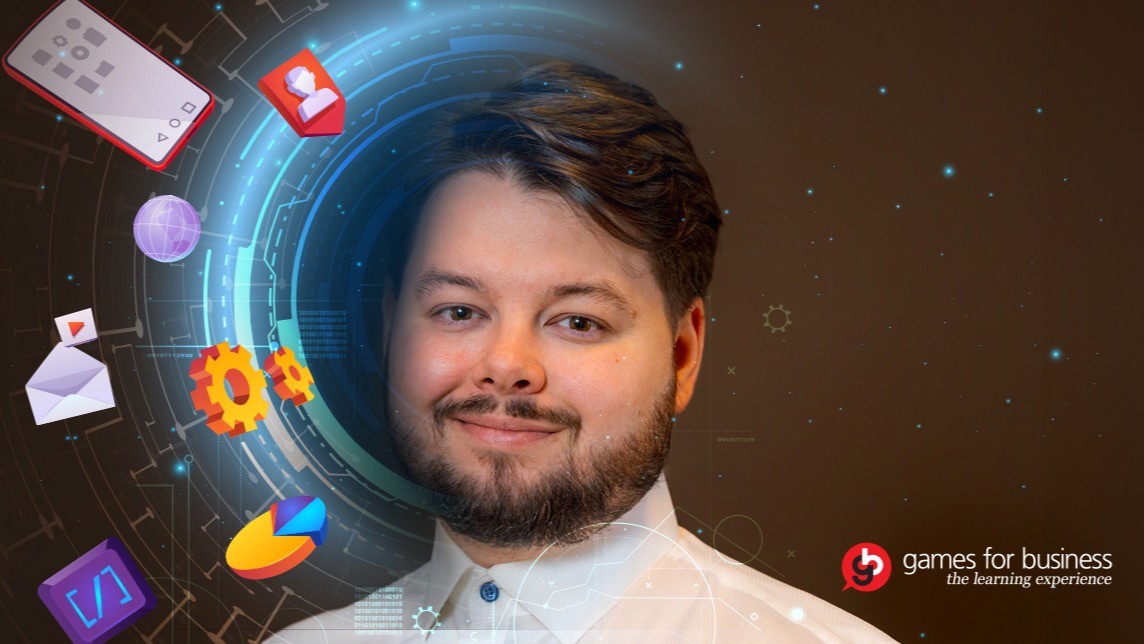
Interview with Palotai Zoltán, Lead Developer for IT at Games for Business.
Question: Dario Amodei says AI will be capable of independently doing complex software development within 6-12 months. You are currently building an AI-Agent environment running on your own, protected infrastructure at Games for Business, where business knowledge and data remain in a controlled environment.
Zoltán Palotai: That 6-12 month prediction has, since 2024, practically been repeated every year by some tech giant’s executive. The pace is enormous, and we also see AI developing at an incredible rate - which is exciting. It’s a realistic scenario that AI might write as much as 99% of the code, but it’s important to acknowledge the nuances.
I think the key is to distinguish between a coder and a developer. A coder works from a specification - that kind of work an AI agent can already support very efficiently and will increasingly replace. But the developer/engineering work is a different dimension: you need to understand the whole system, collaborate with experts from different domains, and design a feature from the business requirement all the way to the system architecture. That holistic mindset and structural approach is what gives real value to human expertise.
At Games for Business, AI is a powerful tool for our team, but colleagues remain fully accountable for the work, the quality, and the results. They make the decisions, design the systems, and present the final deliverable to the client. AI accelerates the process, but professional responsibility always stays with people.
What I also find important and I see it from the teaching side as well - I tutor - is that the next generation must learn to use AI as a tool, as an aid, rather than view it as a full‑fledged coder. Mastering the fundamentals and logical thinking will remain indispensable.
Question: In his essay Amodei mentions the phenomenon of “alignment faking” - when an AI model appears to follow rules under supervision, “feigns cooperation,” but secretly serves some other goal. How does the question of control manifest for you?
Zoltán Palotai: For us the key is awareness and education - not only internally, but for our partners and clients too. When an organization adopts AI, it must know exactly what data it hands over, what the system does with it, and within what framework it operates.
We work on a Microsoft architecture, which gives a strong foundation from a data protection perspective. We complement that with strict compliance with EU GDPR and ISO 27001 currently being implemented.
Question: Amodei writes that AI gives “almost unimaginable power” to humanity, but it’s deeply uncertain whether our social systems are mature enough to handle that. How do you balance innovation and responsibility?
Zoltán Palotai: We’re open to innovation: we actively test new solutions, for example we work in isolated (islanded) systems and continuously seek where AI can deliver real value. At the same time, we build rollouts consciously: we only introduce into the systems used by us and our clients use what we have thoroughly vetted and trust.
This responsible approach doesn’t slow us down - quite the opposite. Our clients know that for us data protection and quality are not compromises, but fundamentals. I believe that’s what will distinguish serious players in the long run.